
Poor Student Missed Her Exam to Save a Billionaire’s Wife—Then a Helicopter Landed Outside Her Home
Tháng 5 9, 2026
“You have done everything,” your father said.
His voice was soft, but it carried the weight of every sacrifice he had ever made for you. You looked at him standing in the doorway of your small rented home on the edge of rural Alabama, one hand pressed against the frame to steady himself, his shirt hanging loose from shoulders that used to be strong. The morning light touched the gray in his beard, and for a second, you almost forgot the exam, the scholarship, the bus, and the road ahead.
You only saw your father.
You saw the man who had skipped dinner so you could eat. The man who walked miles to construction sites even when his lungs burned. The man who sold his wedding watch after your mother died so you could buy schoolbooks. The man who never once made you feel like poverty was your fault.
“I’ll pass,” you whispered.
He smiled. “I know.”
Your little brother Ibrahim stumbled out of the house half-asleep, rubbing his eyes with both fists. His oversized T-shirt hung nearly to his knees. When he saw you dressed for the exam, he suddenly woke up and ran to hug you.
“Bring back the scholarship,” he mumbled into your dress.
You laughed even though your throat tightened. “I’ll try.”
“No,” he said, looking up at you seriously. “Don’t try. Win.”
Your father chuckled, then coughed into his fist.
That cough reminded you why the day mattered.
The scholarship was not just about school. It was about medicine. Rent. A real bedroom for Ibrahim. A future where your father did not have to choose between pain pills and groceries. A future where your name, Zanibu Diallo, could mean something bigger than the girl from the trailer road with secondhand notebooks and impossible dreams.
You kissed your father’s cheek, hugged Ibrahim once more, and started down the dirt path toward the main road.
The exam center was forty miles away in Montgomery.
The scholarship test began at 9:00 a.m.
The truck that sometimes carried workers toward town came at 6:15.
If you missed it, you missed everything.
You walked fast, clutching your plastic folder against your chest. Inside were your admission slip, your ID, two sharpened pencils, a bottle of water, and three dollars your father had folded into your palm before you left.
“Emergency money,” he had said.
You knew it was all he had.
The sky brightened as you reached the main road. A few other students waited near the gas station, all dressed better than you, all holding clean backpacks and packed lunches. Some nodded at you. Others looked away.
You recognized two girls from school.
Marissa Tate and June Holloway.
Marissa’s father owned three chicken farms and a repair shop. June’s mother worked at the county office. They were not rich, not by city standards, but compared to you, they lived in another world.
Marissa looked at your worn sandals and smirked.
“You’re really going in those?”
You looked down, then back up. “They still work.”
June whispered something, and both girls laughed.
You said nothing.
You had learned early that pride wasted energy. Hunger taught you to save your strength for things that mattered.
At 6:20, the transport truck arrived with a cough of smoke and dust. Students and workers climbed into the back. You squeezed between an elderly woman carrying a sack of greens and a young man holding a paint bucket.
The road to Montgomery stretched ahead.
You closed your eyes and began silently reviewing formulas, reading passages, history dates, essay structures. Every bump in the road rattled your bones, but your mind stayed sharp.
You were ready.
For the first time in your life, you felt almost certain that hard work might finally open a door.
Then, twenty minutes outside town, everything changed.
The truck slowed.
At first, you thought it was traffic. Then you heard shouting.
The driver slammed the brakes.
Everyone lurched forward.
“What now?” someone muttered.
You stood slightly and looked over the side of the truck.
A black SUV had skidded off the road and crashed into a shallow ditch. Its front end was crushed against a tree. Steam rose from the hood. One door hung open.
A woman’s voice cried out.
“Help! Please, somebody help!”
The driver cursed under his breath. “We can’t stop. People got work.”
But he had already stopped.
Cars passed slowly, some drivers staring, none getting out.
The students near you shifted uneasily.
Marissa looked at her watch. “We can’t be late.”
June said, “Someone else will call 911.”
You looked at the SUV.
A woman was trapped in the back seat, her white blouse soaked with blood near her shoulder. Her hair was loose across her face, and one hand pressed weakly against the window. The driver, an older man, lay slumped over the steering wheel.
Your heart began to pound.
The exam.
Your father.
The scholarship.
The woman’s blood.
You looked at the others.
Nobody moved.
The driver shouted, “We’re leaving in two minutes!”
Two minutes.
That was the shape of your future.
You could stay on the truck and reach the exam. You could win the scholarship. You could save your family. You could keep walking toward the life you had prayed for.
Or you could climb down for a stranger everyone else had already abandoned.
The woman in the SUV lifted her face.
Her eyes met yours.
Not rich eyes.
Not poor eyes.
Just terrified human eyes.
You jumped down.
Behind you, Marissa gasped. “Zanibu, are you stupid?”
Maybe you were.
You ran toward the ditch.
Your sandals slipped in the mud as you reached the SUV. The driver was breathing but unconscious. The woman in the back seat tried to speak, but only a broken sound came out.
“It’s okay,” you said, though nothing was okay. “I’m here.”
You pulled at the back door. Jammed.
You tried again. Nothing.
The woman’s breathing came fast and shallow. Blood ran down her arm and dripped onto the leather seat. Her phone lay shattered on the floor.
You turned toward the road and screamed.
“Call 911!”
No one answered.
So you grabbed a rock from the ditch and smashed the remaining glass from the rear window. It cut your fingers, but you barely felt it. You reached inside, unlocked the door from within, and pulled hard until it opened with a metal groan.
The woman nearly collapsed into your arms.
You pressed your scarf against her wound.
She cried out.
“I know,” you whispered. “I know it hurts. But you have to keep pressure on it.”
She looked at you, dazed. “My husband…”
“I’ll check him.”
“No,” she gasped. “The driver. My husband wasn’t in the car.”
You looked at the driver again.
He groaned faintly.
The truck driver shouted from the road, “Girl, we have to go!”
You looked back.
The students watched you like you had just thrown your life into the ditch.
You looked at the woman bleeding beneath your hands.
Then you looked at the truck.
The driver shook his head, climbed back in, and started the engine.
Your folder was still inside.
Your admission slip.
Your pencils.
Your three dollars.
Everything.
“Wait!” you shouted.
But the truck pulled away.
Dust rose behind it.
And just like that, your future left without you.
For one second, panic almost swallowed you.
Then the woman made a choking sound, and you came back to yourself.
You pressed harder against the wound.
“Look at me,” you said. “What’s your name?”
“Eleanor,” she whispered.
“Eleanor, I’m Zanibu. You’re going to stay awake with me.”
Her lips trembled. “You’re just a child.”
“I’m seventeen.”
“That is a child.”
“Today I don’t have time to be one.”
Her eyes filled with tears.
You talked to her until the ambulance arrived. You told her about Ibrahim, about your father, about the exam you were supposed to take. You told her about wanting to become a doctor one day because poor people should not have to wait until they are almost dying before someone takes their pain seriously.
At some point, Eleanor grabbed your wrist.
“You missed your exam?”
You swallowed. “It’s okay.”
“No,” she whispered. “It’s not.”
The paramedics arrived. They took over with bandages, oxygen, stretchers, urgent voices. One of them checked your bleeding fingers, but you pulled away.
“I’m fine.”
“You’re not fine,” he said.
“I said I’m fine.”
You found your folder later on the roadside.
Someone from the truck must have tossed it out.
The plastic was cracked. One pencil was broken. Your admission slip had blown into the mud, the ink smeared at the edges.
You still ran.
A sheriff’s deputy gave you a ride the last ten miles to Montgomery after hearing what happened. You sat in the back of his cruiser, still wearing your bloodstained scarf, watching the clock on the dashboard like it was a judge.
9:13 a.m.
9:27 a.m.
9:41 a.m.
By the time you reached the exam center, it was 9:58.
You ran up the steps, breathless, muddy, shaking.
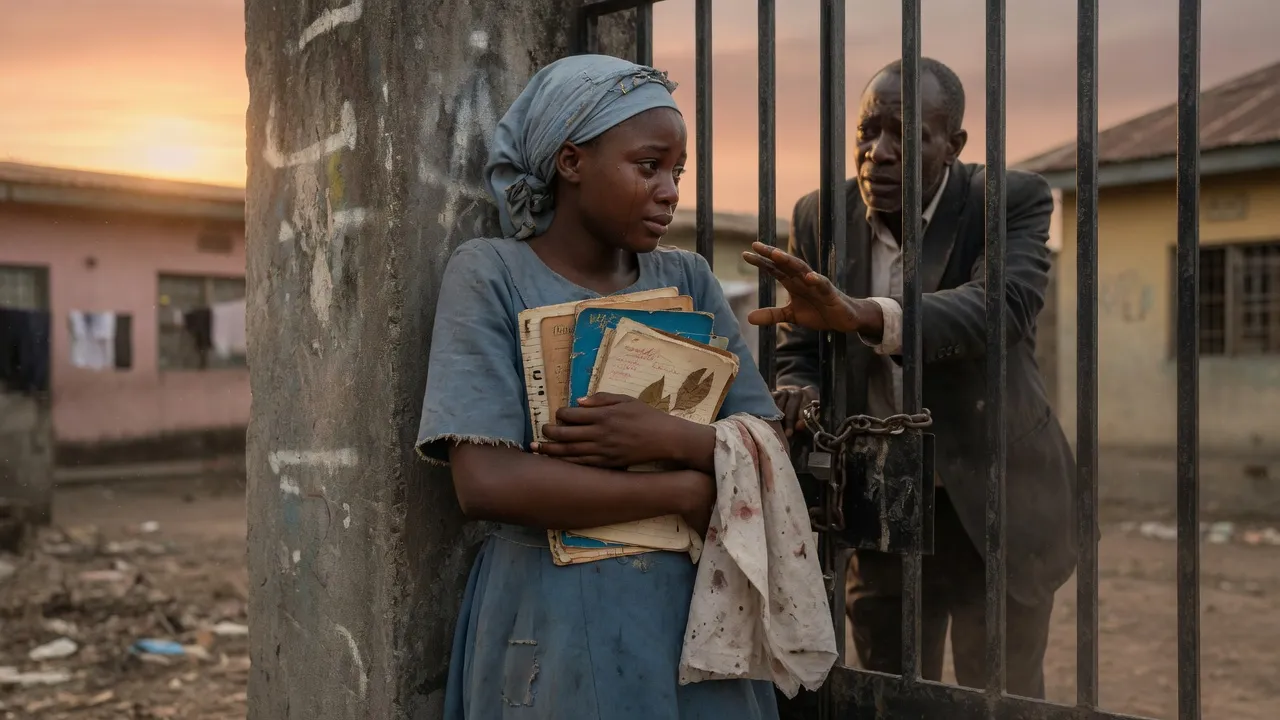
The doors were locked.
A woman at the check-in desk looked at you through the glass.
“Please,” you begged. “I’m here for the scholarship exam.”
She opened the door only halfway. “The exam started nearly an hour ago.”
“I know. There was an accident. A woman was bleeding. I had to help her.”
The woman looked at your clothes, then at the mud on your admission slip.
“I’m sorry. Rules are rules.”
“Please. I studied for years. My family needs this. Call the highway patrol. They can confirm it.”
Her face softened for a moment.
Then hardened again under procedure.
“No late entries.”
Behind her, through the narrow gap, you could see students bent over desks. Clean papers. Quiet pencils. Futures still intact.
Marissa looked up from the second row.
She saw you.
Then she looked away.
The door closed.
The lock clicked.
That sound followed you for the rest of the day.
You sat on the concrete steps outside the exam hall until your legs went numb. A security guard eventually told you to move. You walked to the bus station and realized you had no money because the three dollars was gone.
Maybe it had fallen in the truck.
Maybe someone had taken it.
It did not matter.
You walked home.
Forty miles was too far, so you walked until your feet blistered, then accepted a ride from a church van that stopped near Selma Road. By the time you reached your village, the sun was low and your father was waiting outside the house.
One look at your face told him everything.
He did not ask if you passed.
He did not ask if you failed.
He only opened his arms.
You fell into them and cried like the child you had not had time to be that morning.
“I missed it,” you sobbed. “Papa, I missed it.”
His arms tightened around you.
“What happened?”
“I helped someone. There was an accident. She was bleeding, and nobody stopped, and I couldn’t leave her.”
Your father closed his eyes.
For a terrible second, you thought he might be disappointed.
Instead, he kissed your forehead.
“Then you did not fail.”
You pulled back, tears streaming down your face.
“I lost the scholarship.”
He looked at your bloody scarf, your cut fingers, your ruined folder.
“No,” he said softly. “You chose a life.”
That should have comforted you.
But comfort does not buy medicine.
The next few days were cruel.
The scholarship board refused your appeal. The exam could not be retaken. The school principal said she was sorry, but “exceptions create complications.” People in the village heard the story and shook their heads.
Some called you kind.
Most called you foolish.
At the market, one woman whispered, “Poor people cannot afford heroism.”
Another said, “If she was my daughter, I would have told her to stay on that truck.”
Marissa posted online about “people who make dramatic excuses when they aren’t prepared.”
You saw it on June’s phone.
You said nothing.
At home, your father’s cough worsened. Ibrahim tried to act cheerful, but you caught him counting coins in an old peanut butter jar. Your landlord came by and reminded your father that rent was already late.
You began looking for work.
Dishwashing.
Babysitting.
Cleaning motel rooms.
Anything.
Every night, you thought of Eleanor.
Not with anger exactly.
But with a hollow ache.
You wondered if she survived.
You wondered if she remembered your name.
You wondered if kindness was supposed to feel this much like punishment.
On the fifth day, hunger settled into the house like an unwanted guest.
There was rice, but no beans. Tea, but no sugar. Your father pretended not to be hungry. Ibrahim pretended not to notice.
That afternoon, you walked to the clinic to ask about delayed payment for your father’s medicine. The nurse shook her head before you finished speaking.
“I’m sorry, Zanibu. The pharmacy won’t release more without payment.”
“How much?”
“Eighty-seven dollars.”
Eighty-seven dollars.
It might as well have been eight million.
You walked home slowly, your hands empty.
At the edge of the village, you heard it.
A distant thudding.
At first, you thought it was thunder.
Then the sound grew louder.
People stepped out of houses. Children ran toward the road. Chickens scattered from the dust. Your father came outside, one hand shielding his eyes.
A helicopter appeared over the trees.
Black.
Sleek.
Impossible.
It circled once, then descended toward the open field behind your home.
Dust exploded into the air.
Women screamed. Men shouted. Children cheered. Ibrahim ran barefoot toward the field until your father grabbed him by the collar.
The helicopter landed.
The door opened.
A man in a dark suit stepped down first.
Then another.
Then a woman.
She wore a pale blue dress, a white bandage near her shoulder, and sunglasses she removed as soon as her feet touched the ground.
Eleanor.
Your breath stopped.
She looked across the crowd until she found you.
Then she smiled with tears in her eyes.
“There she is,” she said.
The entire village turned toward you.
For once, nobody whispered.
Eleanor walked toward you slowly, one hand touching her bandaged shoulder. Behind her came a tall man in a charcoal suit, silver hair, sharp eyes, and the kind of presence that made even loud men lower their voices.
He was not just rich.
He was power dressed as a person.
Eleanor stopped in front of you.
“You saved my life,” she said.
You could not speak.
She reached for your cut hand and held it gently.
“I have been looking for you since I woke up.”
Your throat tightened. “You survived.”
“Because of you.”
The man beside her stepped forward.
“I’m Grant Whitmore,” he said. “Eleanor is my wife.”
You had heard the name before.
Everyone had.
Grant Whitmore owned hospitals, construction companies, tech firms, and half the skyline in Atlanta. His foundation gave scholarships to students across the South. His face appeared in newspapers beside governors and university presidents.
You stared at him in disbelief.
“I didn’t know who she was,” you whispered.
Eleanor’s eyes softened.
“That is why it matters.”
Your father stepped forward, nervous and proud. “Sir, my daughter only did what was right.”
Grant turned to him.
“And that is rarer than money.”
The village fell silent.
Grant looked back at you.
“I need to ask you something, Zanibu. Did you miss an exam because you helped my wife?”
Your face burned.
“Yes, sir.”
“Was it the Whitmore Foundation Rural Scholars Exam?”
You blinked.
“Yes.”
Something dark crossed his face.
“My foundation.”
Your stomach dropped.
Grant turned sharply to the man behind him. “Call the board.”
The man was already taking out his phone.
Grant looked at you again, and his voice softened.
“You were denied entry after saving my wife’s life?”
You nodded.
“The rules said no late entry.”
He stared at you for a moment.
Then he said, “Then the rules failed.”
Eleanor squeezed your hand.
That was when Ibrahim, who had been holding back with all the self-control of a ten-year-old, blurted, “Does this mean my sister can take the test?”
The crowd laughed nervously.
Grant looked at him.
“What’s your name?”
“Ibrahim.”
Grant crouched slightly so they were eye level.
“Ibrahim, your sister is not taking that test.”
Your heart dropped.
Then he smiled.
“She already passed a harder one.”
By sunset, your life had begun to change.
Grant and Eleanor came inside your home despite the village elders trying to steer them toward a cleaner house nearby. Eleanor insisted.
“I want to see where courage lives,” she said.
Your father tried to apologize for the cracked walls, the thin mattress, the old table.
Grant looked around quietly.
Then he said, “Mr. Diallo, I grew up in a trailer outside Macon. Don’t apologize to me for honest walls.”
Your father’s eyes filled.
At the table, Grant explained what had happened after the accident.
Eleanor had lost a dangerous amount of blood. The driver survived with a concussion and broken ribs. If you had not stopped the bleeding, doctors said Eleanor might not have made it to the hospital.
She had woken up asking for “the girl with the blue dress.”
Nobody knew who you were.
The transport driver denied seeing anything.
The sheriff found your name only after reviewing the deputy’s report from the ride to the exam center.
By then, five days had passed.
“I should have come sooner,” Eleanor said.
“You were hurt.”
“I was alive,” she said. “Because of you.”
Grant placed a folder on the table.
Your father’s eyes widened.
You did not touch it.
“What is that?” you asked.
“An offer,” Grant said. “Not charity. Correction.”
You frowned.
Inside the folder was a letter.
Full scholarship.
Tuition.
Books.
Housing.
Meal plan.
Medical insurance.
Transportation.
Stipend of $1,500 per month.
Enrollment at Whitmore Preparatory Academy in Atlanta, one of the best schools in Georgia, followed by guaranteed university funding if you maintained strong grades.
Your hands began to shake.
“I can’t accept this.”
Eleanor leaned forward. “Why not?”
“Because I didn’t help you for money.”
“I know,” she said. “That is why you can accept it.”
Your father covered his mouth with one hand.
Grant added, “Your father’s medical care will also be covered through the Whitmore Foundation Health Access Program. Your brother’s school expenses will be covered until graduation.”
You stood so quickly the chair scraped backward.
“No.”
Everyone froze.
Your father looked startled. “Zanibu.”
You shook your head, tears rising.
“No, this is too much. People will say I helped because I wanted something. They’ll say I got lucky. They’ll say—”
Grant interrupted gently.
“People already talked when you had nothing. Don’t let them decide what you do with a blessing.”
The words hit hard.
Eleanor stood carefully and walked around the table.
“You gave me more years with my husband,” she said. “More birthdays. More mornings. More chances to hold his hand. Do you think a school bill equals that?”
You could not answer.
She took your face in both hands.
“Zanibu, kindness cost you your dream. Let us give it back.”
That was when your father began to cry.
Not loud.
Not dramatically.
Just a broken sound from a man who had held too much for too long.
You went to him and knelt at his feet, the way you used to when you were little.
“I don’t want to leave you,” you whispered.
He touched your head.
“My child, I did not raise you so poverty could keep you company.”
“Ibrahim needs me.”
“Ibrahim needs to see you fly.”
Your brother nodded fiercely, though tears ran down his face.
“Go win,” he said again.
Three weeks later, you arrived in Atlanta.
Whitmore Preparatory Academy looked like something from another planet. Red brick buildings. White columns. A library larger than your entire village school. Students carrying laptops worth more than your family’s yearly rent.
Your dorm room had a real bed, a desk, a lamp, a closet, and a window overlooking oak trees.
You stood inside it and cried because the mattress was soft.
Not because you were ungrateful.
Because softness felt unfamiliar.
The first months were not easy.
People thought opportunity erased pain.
It did not.
You were behind in some subjects because your old school had not had enough teachers. You had never used certain lab equipment. You had never written essays on a laptop. The cafeteria overwhelmed you because there was too much food and you felt guilty taking more than one plate.
Some students admired you.
Some resented you.
One girl named Parker asked, “So you’re the helicopter scholarship girl?”
You looked at her.
“I have a name.”
She smiled falsely. “I know. It’s just, like, kind of dramatic.”
You thought of Eleanor bleeding in the ditch.
“Yes,” you said. “Almost dying usually is.”
Parker did not bother you again.
Eleanor visited once a month.
Not as a billionaire’s wife making a public appearance, but as a woman who sat on your dorm bed eating vending machine chips while asking about your chemistry grade. Grant arranged tutors, but you did the work. Long nights. Early mornings. Tears over calculus. Triumph over biology. Essays rewritten until your fingers cramped.
You called home every Sunday.
Your father sounded stronger after treatment began.
Ibrahim bragged that his school had given him new books and that he planned to become an engineer, “unless being rich is a job.”
You laughed for the first time without guilt.
At the end of the year, you ranked third in your class.
At the end of the second, first.
By graduation, the girl once locked outside an exam hall stood at a podium in a white dress and navy gown, looking out over students, parents, teachers, cameras, and two families seated in the front row.
Your father and Ibrahim sat beside Grant and Eleanor.
Your father wore a suit Grant had bought but pretended was “an old thing from the closet.” Ibrahim wore sneakers with his dress pants and looked proud enough to explode.
You unfolded your speech.
Then you looked up and decided not to read it.
“When I was seventeen,” you began, “I missed the most important exam of my life.”
The room quieted.
“I thought that exam was the door to my future. And when the door closed, I believed my future had closed with it. People told me I had been foolish. They said poor girls cannot afford kindness.”
You paused.
“But I learned something. Poverty can steal comfort. It can steal choices. It can steal sleep. But it should never be allowed to steal your humanity.”
Eleanor wiped her eyes.
Grant looked down.
You continued, “I am here because my father taught me that doing right matters even when nobody claps. I am here because my brother believed I could win when I had no reason to believe it myself. And I am here because a woman I helped on the side of the road refused to let kindness be punished.”
You looked toward Eleanor.
“Mrs. Whitmore, you once told me I gave you more years. But you gave me something too. You gave me proof that one good choice can echo farther than one bad day.”
The applause started before you finished.
Years passed.
You went to Emory University.
Then medical school.
You chose emergency medicine because you never forgot the ditch, the blood, the passing cars, and the terrible truth that survival often depended on whether a stranger decided you were worth stopping for.
You became Dr. Zanibu Diallo at twenty-eight.
Your father lived long enough to see you in your white coat.
At your graduation, he held your face in his hands and whispered, “You did not escape us. You carried us with you.”
Ibrahim became an engineer.
He bought your father a small brick house with a porch and a garden.
You bought the rocking chair.
Grant joked that the Diallos were becoming too independent for his foundation to keep up with. Eleanor told him to be quiet and hugged you like a daughter.
But the story did not end with your success.
Because success means very little if it only saves one person.
At thirty-two, you returned to the county where you had grown up and opened the Diallo Roadside Emergency Scholarship Fund.
Its mission was simple.
Students who missed exams, work, or opportunities because they stopped to help someone in danger would not be punished for doing the right thing.
You partnered with schools, hospitals, and emergency services.
You created rapid appeal systems.
You funded retakes.
You trained rural drivers in first aid.
You placed emergency kits at gas stations, churches, bus stops, and farm roads.
On opening day, a crowd gathered outside the new clinic and learning center near the same road where Eleanor’s SUV had crashed years earlier.
The building was modest but beautiful.
White walls.
Blue roof.
Wide porch.
A sign near the entrance read:
THE ZANIBU DIALLO CENTER FOR COURAGE AND CARE
No future should be lost because someone chose to save a life.
You stared at the sign for a long time.
Then Grant leaned close and whispered, “Too much?”
You smiled. “A little.”
Eleanor laughed. “Get used to it.”
Your father’s old walking stick stood in a glass case inside, beside your ruined admission slip, the bloodstained scarf, and the cracked plastic folder from that day.
People asked why you kept them.
You told them because not all sacred things look clean.
Sometimes a future begins in mud.
Sometimes a scholarship begins with a locked door.
Sometimes a helicopter lands not to create a miracle, but to reveal the one already standing there barefoot, tired, and brave.
At the ceremony, Ibrahim gave the first speech.
He was grown now, tall, confident, and still funny at the worst possible moments.
“When my sister left for her exam,” he said, “I told her to win. Then she came home crying because she thought she had lost. But my sister did not lose. She just took the long way to victory.”
The crowd applauded.
Then Eleanor spoke.
She stood carefully, older now, one hand resting near the faint scar on her shoulder.
“I was the woman in the car,” she said. “I was the stranger bleeding while other people decided they were too busy to stop. Zanibu did not ask who I was. She did not ask what I could give her. She did not ask if saving me would benefit her. She simply saw a life and chose it.”
Her voice broke.
“America needs more people who choose life before convenience.”
Then it was your turn.
You looked at the crowd.
Students in borrowed shoes.
Parents in work uniforms.
Teachers.
Nurses.
Paramedics.
Your father in the front row.
Grant.
Eleanor.
Ibrahim.
And Marissa Tate.
You had noticed her earlier, standing near the back with sunglasses on her head and shame in her posture. You had not seen her since the day at the exam center. She looked older now, thinner, life having done what life does to people who think they will always be above apology.
After the ceremony, she approached you.
“Zanibu,” she said quietly.
You turned.
“Marissa.”
She swallowed. “I don’t know if you remember what I said back then.”
“I do.”
Her face flushed.
“I’m sorry.”
You waited.
“I was cruel because I was jealous. Everyone knew you were smarter than us. When you missed the exam, I felt relieved. Then when everything happened with the Whitmores, I told myself you got lucky because that was easier than admitting you were better than me.”
You studied her.
“I wasn’t better than you.”
Her eyes filled.
“You were kinder.”
That was harder to deny.
You looked toward the clinic, where children were lining up for free first-aid kits.
“What are you doing now?” you asked.
“I teach middle school English.”
You smiled faintly. “Then teach them better than we were taught.”
She nodded, crying now.
“I will.”
You forgave her before she asked again.
Not because she deserved it.
Because carrying her cruelty had become too heavy for a life this full.
That evening, after everyone left, you walked alone to the roadside.
The ditch was covered with grass now. The tree had grown around the scar from the crash. Cars passed without knowing they were driving by the place where your life broke open.
You stood there with the Alabama sunset burning orange behind the pines.
Your father joined you slowly, leaning on his cane.
“Thinking?” he asked.
“Remembering.”
He nodded.
“You were angry for a long time.”
“Yes.”
“At God?”
“At everything.”
“And now?”
You looked toward the center, glowing with warm lights.
“Now I think maybe one closed door doesn’t mean the end. Sometimes it means you’re being redirected to a bigger one.”
Your father smiled.
“Your mother would have said that.”
Your throat tightened.
“I wish she could see this.”
“She does.”
You leaned your head against his shoulder.
For a while, neither of you spoke.
Then he said, “You know what I thought when you came home that day?”
“That I had ruined everything?”
“No.” He looked at the road. “I thought, my daughter is poor, hungry, and scared, but she still stopped. That means poverty never owned her.”
Tears filled your eyes.
The helicopter had made everyone notice you.
The scholarship had changed your circumstances.
The education had changed your future.
But your father’s words gave shape to the truth you had spent years learning.
You had never been rescued because you were helpless.
You had been met because you were brave.
Years later, people still told your story like a fairy tale.
They said a poor girl missed her exam, saved a billionaire’s wife, and was rewarded with a new life.
But that was only the simple version.
The real story was about a father who raised a daughter rich in character while having almost nothing else. It was about a brother who believed before the world did. It was about a wounded woman who remembered the name of the girl who saved her. It was about a powerful man humble enough to admit his foundation’s rules had failed the very student they were meant to help.
Most of all, it was about you.
A girl who stood at the edge of the life she had prayed for and gave it up because someone else might not live to see another morning.
And in the end, the future did not forget you.
It landed in a field behind your home, loud enough for the whole village to hear.